Why Oat Milk Viscosity Changes After UHT and Holding
For an oat milk factory, viscosity is not just a texture attribute. It affects pumping load, heat transfer, homogenization behavior, filtration pressure, line speed, filling accuracy, and the number of corrective conversations that happen after a batch has already moved downstream.
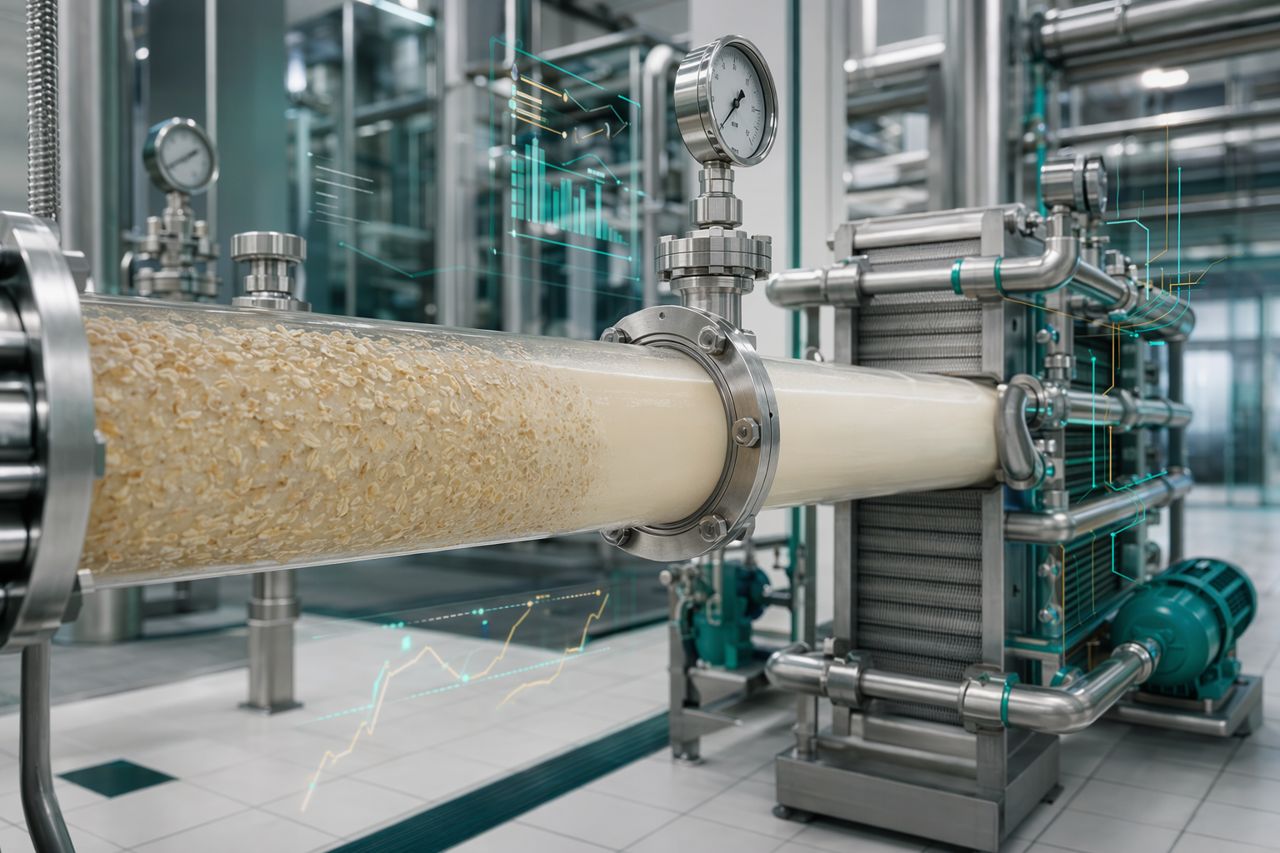
The difficult part is that oat milk can look controlled before UHT, then change during thermal processing, holding, or early shelf-life. A batch that entered the system as a smooth, manageable base can leave as a heavier beverage, a thin and sharp-tasting beverage, or a product with drift between first fill and later evaluation.
Enzymesboost supplies enzyme systems for oat milk production designed to help manufacturers manage this exact point of instability: the relationship between oat solids, starch conversion, beta-glucan contribution, process heat, residence time, and final mouthfeel.
Why viscosity can move after UHT
Oat milk is a structured liquid. Its flow behavior comes from hydrated oat solids, partially converted starch, soluble fibers, protein, oil, emulsifier performance, homogenization conditions, and the thermal history of the batch.
UHT and holding can expose weak points in the base formulation. When the slurry or beverage contains inconsistent carbohydrate fractions, the heat step may amplify differences that were not obvious in the balance tank.
Common causes include:
- Incomplete starch conversion before thermal processing, leaving material that can swell, interact, or continue to influence body under heat.
- Excess high-molecular beta-glucan contribution, which can increase perceived thickness and create filtration or pumping sensitivity.
- Over-conversion of starch, which may reduce body, flatten mouthfeel, or increase sweetness beyond the intended profile.
- Batch-to-batch oat variability, especially when flour, flakes, or oat base inputs differ in hydration behavior.
- Residence time variation, where the same recipe experiences slightly different thermal exposure through the line.
- Hold-tank effects, including continued hydration, particle interaction, and separation stress before filling.
The result is a product that may pass an in-process check but behave differently after UHT, after holding, or during finished product release.
The process manager’s view: viscosity is a control point
When viscosity shifts late, the cost is rarely isolated to the lab result. It shows up across the plant:
- Higher pressure across filters or separators
- Slower transfer from mix tanks to thermal processing
- Foaming or instability during filling
- Inconsistent mouthfeel between production runs
- More operator intervention to keep the line moving
- Greater risk of product being held for review
- Additional blending or rework decisions
For high-throughput oat milk production, the goal is not simply to make the beverage thinner. The goal is to create the right viscosity window early enough in the process that downstream equipment sees a predictable product.
That is where enzyme selection matters.
How enzymes influence UHT stability
Enzymes used in oat milk processing help shape the carbohydrate profile of the base before UHT. The most relevant functions are typically starch breakdown, control of dextrin profile, and management of soluble fiber-driven viscosity.
A balanced enzyme approach can help production teams:
- Reduce excessive slurry thickness before separation or filtration
- Improve flow through heat exchangers and transfer lines
- Support consistent conversion from batch to batch
- Build a smoother mouthfeel without uncontrolled heaviness
- Reduce finished-product viscosity drift after UHT and holding
- Improve line confidence when oat raw material quality changes
The key is balance. Too little conversion can leave the system heavy and unstable. Too much conversion can create a beverage that tastes overly sweet, feels thin, or lacks the creamy body expected from oat milk.
Enzymesboost focuses on enzyme systems that give manufacturers a practical control lever: not a generic thinning effect, but a defined processing outcome aligned with filtration, thermal performance, and sensory targets.
Why the issue often appears after holding
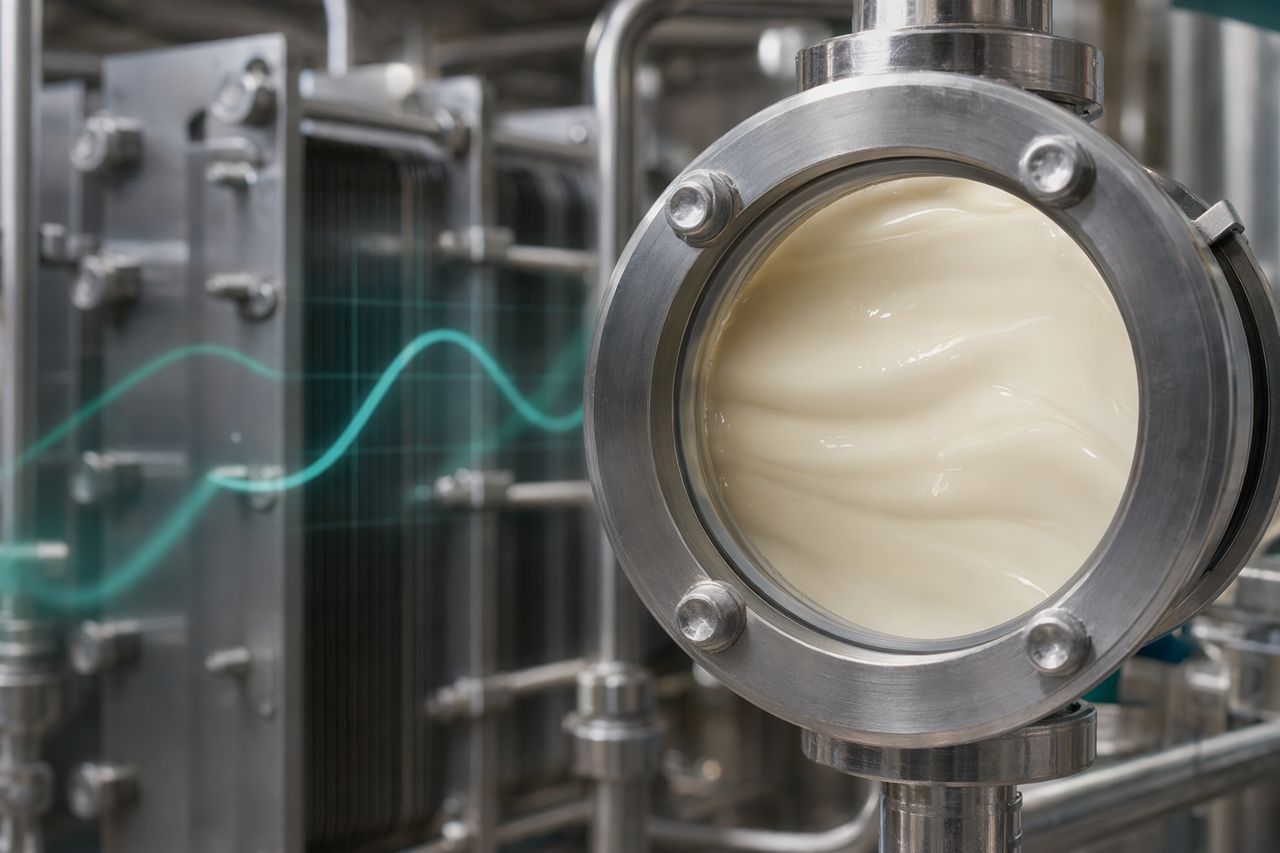
Holding is where hidden variability becomes visible. Even after a successful UHT pass, the beverage continues to settle into its final physical state. Hydrated particles, soluble fibers, converted starch fractions, oil phase behavior, and stabilizer interactions can all continue to influence the finished texture.
If the oat base is not converted consistently before thermal treatment, holding may reveal:
- A gradual increase in body
- A drop in perceived creaminess
- Texture difference between early and late fills
- Sediment sensitivity
- Poor repeatability after storage evaluation
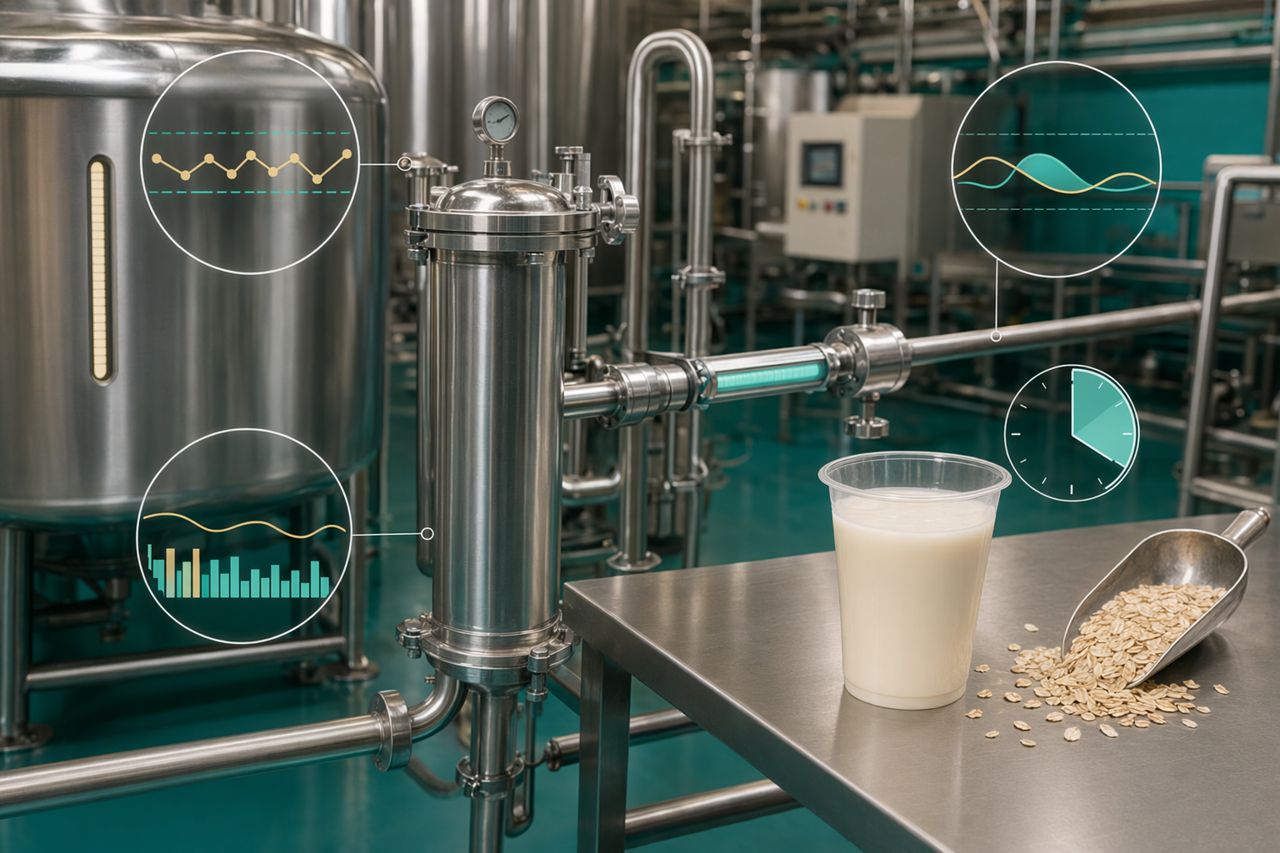
This is why Enzymesboost looks at viscosity as a process outcome, not just a single measurement. The important question is not only, “What is the viscosity now?” It is also, “Will this batch behave the same after heat, after hold, and at release?”
Practical signs your enzyme program needs review
An oat milk factory may benefit from an enzyme review when any of the following are recurring:
- The same recipe produces different flow behavior across oat lots
- UHT inlet behavior is acceptable but outlet texture varies
- Filter or separator performance changes without a clear mechanical cause
- Operators are adjusting process conditions to compensate for thick slurry
- Finished product mouthfeel is inconsistent between production days
- Holding time creates texture drift before filling
- Product development targets are met in pilot batches but not reliably at plant scale
These are not always formulation problems. In many cases, they are conversion-control problems.
What Enzymesboost supplies
Enzymesboost is an enzyme supplier for oat milk production, supporting factories that need dependable carbohydrate conversion, controlled viscosity, and clean process performance.
Our supply approach is built for production teams that care about:
- Throughput stability
- Predictable slurry handling
- Better filtration and separation behavior
- UHT-ready viscosity control
- Batch consistency across raw material variation
- Creamy, commercially acceptable mouthfeel
- Fewer late-stage troubleshooting loops
We work with manufacturers to match enzyme function to the actual process sequence: hydration, cooking or liquefaction, conversion, separation, formulation, homogenization, UHT, holding, and filling.
What to specify when requesting support
To recommend the right enzyme direction, Enzymesboost typically asks for practical plant details rather than academic data. Useful information includes:
- Oat input type: flour, flakes, concentrate, or prepared base
- Current process sequence before UHT
- Where viscosity becomes difficult: mix tank, transfer, filtration, thermal processing, holding, or filling
- Desired mouthfeel: light, balanced, creamy, barista-style, or high-solids
- Whether sweetness is increasing beyond target
- Whether the issue is constant or linked to oat lot changes
- Current pain points in throughput, filtration, or finished product consistency
This helps separate a starch-conversion issue from a beta-glucan viscosity issue, and a process-timing issue from a raw-material variability issue.
The commercial value of better viscosity control
For oat milk factories, enzyme optimization should translate into plant value. The strongest programs reduce uncertainty across production, not just improve one lab attribute.
A well-matched enzyme system can support:
- More stable run rates
- Lower risk of blocked or slow filtration
- Better use of existing thermal capacity
- Reduced need for corrective blending
- More consistent sensory release
- Faster troubleshooting when oat raw materials change
- Stronger confidence when scaling new oat milk formats
In a competitive oat beverage market, consistency is a margin issue. A product that runs smoothly and tastes the same every time is easier to schedule, easier to release, and easier to sell.
Request a quote
If viscosity is changing after UHT or holding, Enzymesboost can help review the enzyme control points in your oat milk process and recommend a supply option aligned with your production goals.
Use the on-site request form to share your process challenge, target mouthfeel, and current production constraints.